How to Plan Clear Workplace Safety Signs
Plan workplace safety signs by mapping the message, decision point, viewing route, proof, approved wording and sign schedule before production.
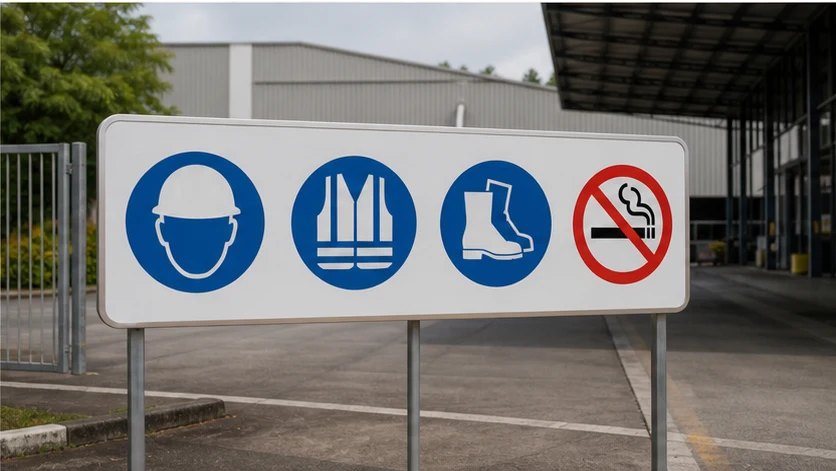
A workplace may need signs at entrances, machines, restricted areas, storage points or route changes. Ordering familiar symbols before mapping the actual risks and viewing positions can leave gaps, duplicates and signs that are difficult to notice.
Plan workplace safety signs by recording the hazard or required action, who needs the message, the decision point, viewing distance, lighting, mounting surface and any approved wording or symbol. Keep each sign focused, test a full-size proof from the real approach route and have the responsible safety person confirm legal and site requirements before production.
What matters most
- Start with the site's risk assessment and responsible safety person, not a generic sign pack.
- Match each message to a location where someone must notice and act on it.
- Use familiar approved symbols and short supporting text where the site requires it.
- Check contrast, glare, obstructions, lighting and viewing distance with a full-size proof.
- Keep an approved sign schedule so wording, quantity and locations stay controlled.
What should be decided before designing a safety sign?
Write one sentence for the purpose of each proposed sign. It may warn about a hazard, prohibit an action, state mandatory protective equipment or direct people to emergency equipment. Do not combine unrelated instructions simply to reduce the number of panels.
Identify the audience and action. A visitor approaching a controlled doorway needs different context from a trained operator beside a machine. Record language needs, direction of approach and whether the person will be walking, driving or working close to the sign.
The site's responsible safety person should supply or approve the final message and symbol. A printer or sign producer can turn an approved brief into a readable panel, but should not invent the risk assessment, emergency route or legal requirement.
Where should workplace safety signs be placed?
Place a sign where the viewer has enough time and space to understand it before reaching the relevant hazard, restriction or action point. Photograph the approach, not only the empty wall, and include doors, shelves, vehicles, equipment, glare sources and competing signs.
Check the sign from the normal route at the busiest realistic time. A panel that looks clear from directly in front may disappear behind an open door or parked trolley. If the approach changes from two directions, test both.
HSE guidance says safety signs should be clear and legible and warns that too many signs can cause confusion. This is useful general design guidance, not a statement of Malaysian compliance. Site-specific Malaysian obligations should be confirmed by the responsible competent person or authority.
How do you make a safety sign easier to notice and read?
Use a recognised, approved symbol rather than redrawing a familiar safety pictogram for style. Keep supporting words short and specific. Decorative type, condensed lettering, busy photographs and low-contrast brand colours can weaken a message that must be understood quickly.
Readability depends on more than letter height. Check contrast, non-glare finish where practical, viewing distance, mounting height, angle and illumination. The U.S. Access Board treats contrast, finish, character style, spacing and viewing distance as separate visual factors; use those principles as design references, not Malaysian legal specifications.
Print or display the proposed artwork at finished size. Stand at the nearest, normal and farthest relevant viewing points. Ask a reviewer who did not prepare the artwork to state the message and action. If they hesitate, simplify the wording, improve contrast or reconsider the location.
A worked example: one doorway, three decisions
Suppose a maintenance-room doorway has restricted access, a required protective item inside and an emergency instruction on a nearby wall. Treat these as three decisions rather than one crowded poster.
At the approach point, the priority may be the access restriction. The mandatory-item instruction may belong closer to where equipment is collected. Emergency information should follow the site's approved emergency plan and remain visible without competing with routine notices.
For each panel, record the message owner, approved symbol or wording, finished size, material, mounting position and viewing route. This creates a clearer quotation brief and an auditable sign schedule without claiming that the example fits every workplace.
What should go into a safety-sign schedule?
Give every proposed sign a simple reference such as S-01, S-02 and S-03. Walk the route with the schedule before approving artwork; this catches missing locations and accidental duplicates more reliably than reviewing isolated artwork files.
- Exact approved wording, symbol reference and purpose.
- Location, annotated site photo and viewing direction.
- Finished width and height, approximate viewing distance and quantity.
- Indoor or outdoor exposure, lighting and mounting surface.
- Material, finish and fixing requirements to be confirmed.
- Language, approval owner, required date and installation scope to be quoted.
Copy-and-send workplace safety sign brief
Send the site and area, sign reference, hazard or required action, exact approved wording and symbol source, responsible safety approver, viewer type, approach direction, viewing distance, exposure, finished size, mounting position, quantity, language, artwork status, installation need, required date and site-access limits.
Attach a full-area photo, approach photo, close mounting photo and annotated location plan. Seri Jadi can quote safety and industrial sign production from an approved brief. Final material, fixing, price, production timing and installation scope depend on the individual job.
Frequently asked questions
Can a sign replace other safety controls?
No. A safety sign communicates a warning, prohibition, required action or direction. It does not replace the site's risk controls, training, guarding, supervision or emergency arrangements. The responsible safety person should decide where signs fit into the wider control plan.
Should every safety sign include words?
Not automatically. Use the symbol, wording and language required by the site's approved system and applicable requirements. Supporting text can clarify a specific message, but too much text can slow recognition. Have the responsible safety approver confirm the final content.
How can we check readability before production?
Review a finished-size proof from the real approach route. Check contrast, glare, lighting, obstructions, viewing distance and whether the intended action is understood quickly. Test every important approach direction and record approval against the sign schedule.
Sources consulted
Sources support the general guidance; the final choice still depends on the actual job.
Send Seri Jadi an approved sign schedule with the exact wording and symbol references, finished sizes, quantities, languages, site photos, mounting details, installation need and required date. Final materials, fixing, price, production timing and installation scope are confirmed for the individual job.
WhatsApp +60 10-451 8088